AQA · GCSE · English Language
Writers’ viewpoints and perspectives
This topic tests your ability to understand and compare how different writers convey their attitudes and perspectives on similar themes across two non-fiction texts from different time periods. It assesses your reading comprehension, analytical skills (AO2), comparison skills (AO3), and your ability to write your own non-fiction text (AO5 & AO6).
- 6 min read
- 3 worked examples
- 5 practice questions
- 8 key terms
Study Notes
Overview
Writers' Viewpoints and Perspectives is a core component of your GCSE English Language reading and writing assessment. This topic requires you to engage with two non-fiction or literary non-fiction texts linked by a common theme. Crucially, these texts will be from different time periods — one from the 19th century, and the other from either the 20th or 21st century.
Your task is twofold. First, as a reader, you must identify what each writer thinks or feels about the topic (their viewpoint), and analyse how they use language and structure to convey that perspective to the reader. You will then compare these methods across the two texts. Second, as a writer, you must adopt your own clear perspective and communicate it effectively to a specified audience in a particular form.
Listen to our 10-minute revision podcast to reinforce your understanding of these core concepts:
Reading Skills
Identifying Information & Ideas (AO1)
The foundation of your analysis is accurate comprehension. You must be able to locate both explicit information (facts clearly stated in the text) and implicit information (ideas suggested or implied by the writer). When reading a 19th-century text, be prepared for complex sentence structures and formal vocabulary; read carefully to extract the core meaning before attempting to analyse the methods.
Analysing Language (AO2)
Examiners award marks for your ability to explain how language choices influence the reader. You must move beyond merely spotting techniques (e.g., 'the writer uses a metaphor') to explaining the precise effect of that technique in conveying the writer's viewpoint.
Key Language Features to Identify
| Feature | Definition | Effect on Reader | Example |
|---|---|---|---|
| Metaphor | Describing one thing as if it were another, without using 'like' or 'as'. | Creates a vivid, often emotive image that frames the writer's perspective on the subject. | 'The city was a vast machine devouring its workers.' |
| Emotive Language | Words chosen specifically to provoke an emotional response. | Manipulates the reader to feel sympathy, anger, or outrage, aligning them with the writer's view. | 'The wretched degradation of the poor.' |
| Direct Address | Using pronouns like 'you' or 'we' to speak directly to the reader. | Closes the distance between writer and reader, making the issue feel personally relevant and urgent. | 'We cannot ignore this crisis any longer.' |
| Semantic Field | A group of words related to a single topic or theme. | Builds a cumulative atmosphere or tone that reinforces the writer's attitude. | Words like 'battle', 'defeat', 'victory' (Semantic field of war). |
| Rhetorical Question | A question asked for effect, not requiring an answer. | Challenges the reader to agree with the writer's implicit conclusion. | 'Who could witness such suffering and remain silent?' |
| Hyperbole | Deliberate exaggeration for emphasis. | Highlights the intensity of the writer's feelings and makes their perspective seem indisputable. | 'It was the worst disaster in human history.' |
Analysing Structure (AO2)
Structural analysis is often neglected by candidates, but it is a rich source of marks. Structure refers to how the writer organises their text to guide the reader's response.
Look for:
- Openings: Does the writer start with a shocking fact, a personal anecdote, or a bold statement? This establishes their immediate purpose.
- Shifts in Focus: Does the text move from the general to the specific, or from description to persuasion? These shifts track the development of the writer's argument.
- Sentence Variation: Short, punchy sentences project confidence and urgency. Long, complex sentences (common in 19th-century texts) can convey authority, detailed reasoning, or overwhelming emotion.
- Paragraphing: A single-sentence paragraph draws immediate attention to a key point.
Comparing Writers' Viewpoints (AO3)
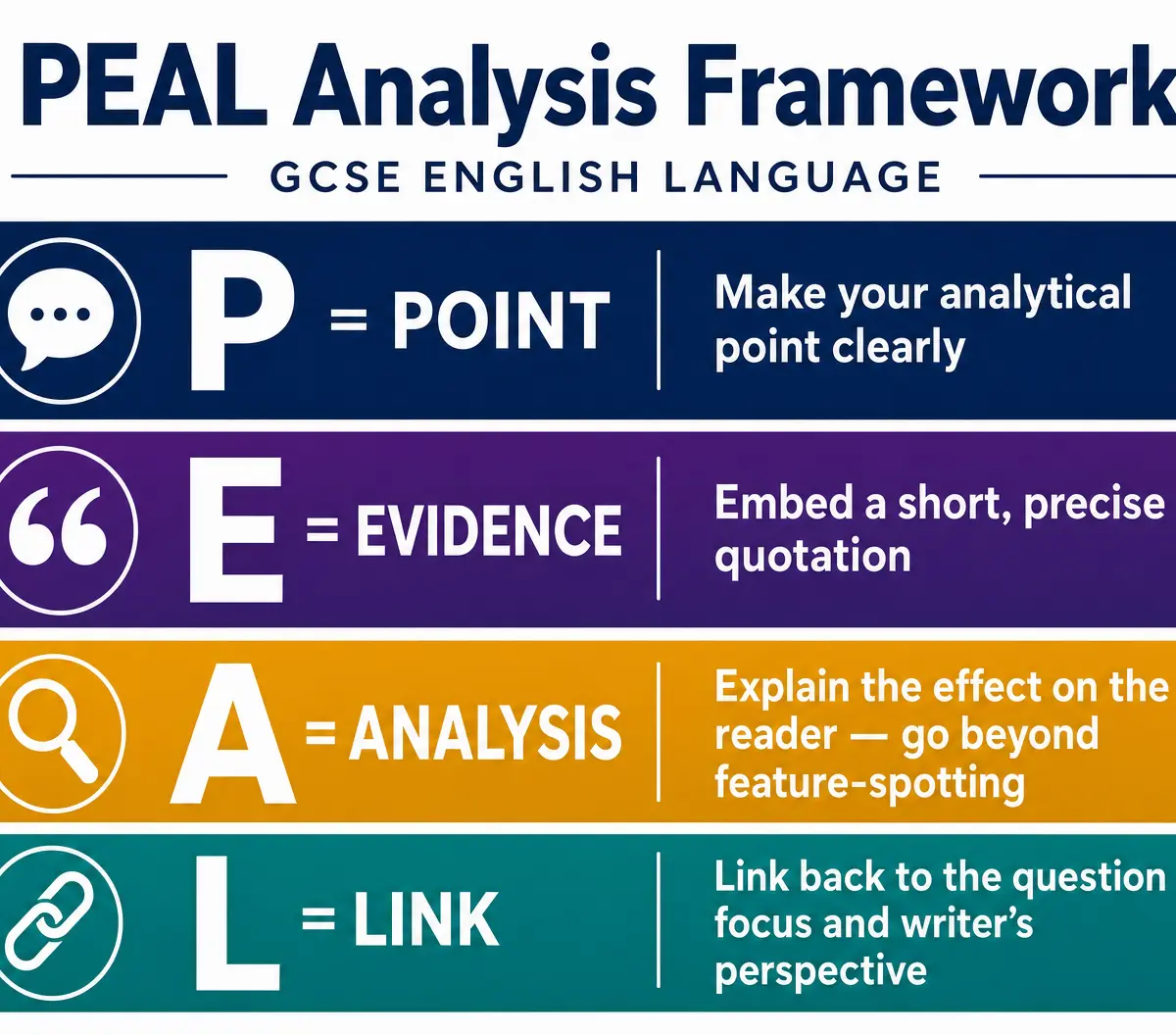
The comparison question is typically the highest-tariff question in the reading section. You must compare both the ideas (what the writers think) and the methods (how they convey it).
The Comparison Framework:
- Identify the Viewpoints: State clearly what Writer A thinks and what Writer B thinks about the shared topic.
- Compare the Methods: How does Writer A use language/structure compared to Writer B?
- Consider the Context: Acknowledge that the 19th-century writer's perspective is shaped by their era (e.g., Victorian attitudes to class or gender), while the modern writer's perspective reflects contemporary values.
- Evaluate Effectiveness: Which approach is more powerful, and why?
Writing Skills
Transactional/Non-Fiction Writing (AO5 & AO6)
In the writing section, you will be asked to present your own viewpoint on a topic. This assesses your ability to adapt your tone, style, and register to suit a specific Purpose, Audience, and Form (PAF).
- Purpose: Are you writing to argue, persuade, advise, or explain?
- Audience: Are you addressing your peers, the local council, or a broad newspaper readership? Your vocabulary must match your audience.
- Form: If asked for a letter, you need a formal opening and sign-off. If an article, you need a headline and engaging introduction. If a speech, you need direct address and rhetorical devices.
**The AFOREST Technique for Persuasion:**Use a variety of persuasive techniques to make your viewpoint compelling: Alliteration, Facts, Opinions, Rhetorical questions, Emotive language, Statistics, and the rule of Three.
Technical Accuracy (SPaG) (AO6)
Up to 20% of the marks in the writing section are awarded for Spelling, Punctuation, and Grammar.
To access the highest bands, you must demonstrate conscious control of ambitious punctuation:
- Use semicolons (;) to link two closely related independent clauses.
- Use colons (:) to introduce a list or a dramatic statement.
- Use dashes (—) to create a sudden pause or emphasize an afterthought.
- Ensure your paragraphs are cohesive by using discourse markers (e.g., 'Furthermore', 'Conversely', 'Consequently').
Visual Resources
4 diagrams and illustrations
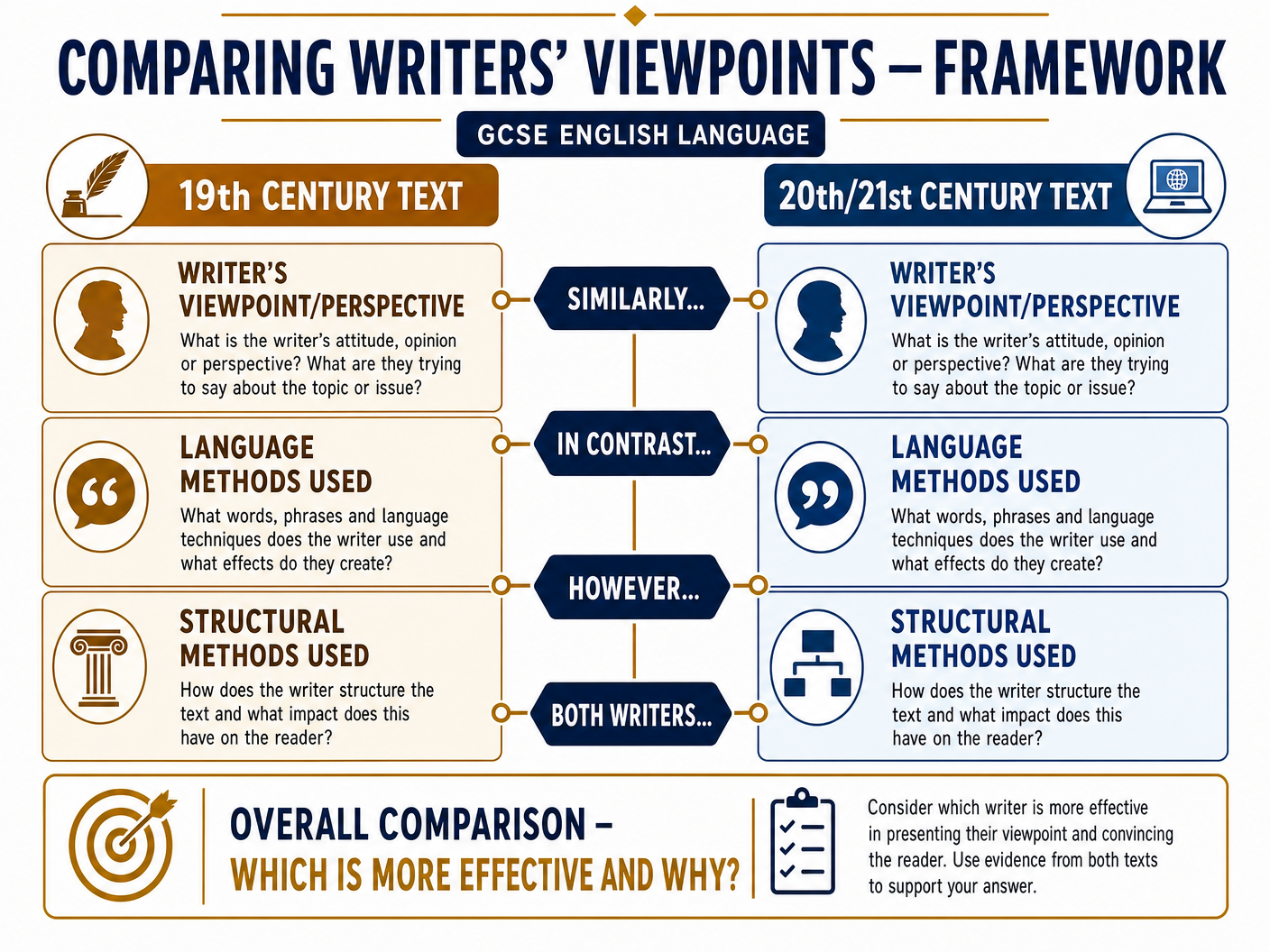
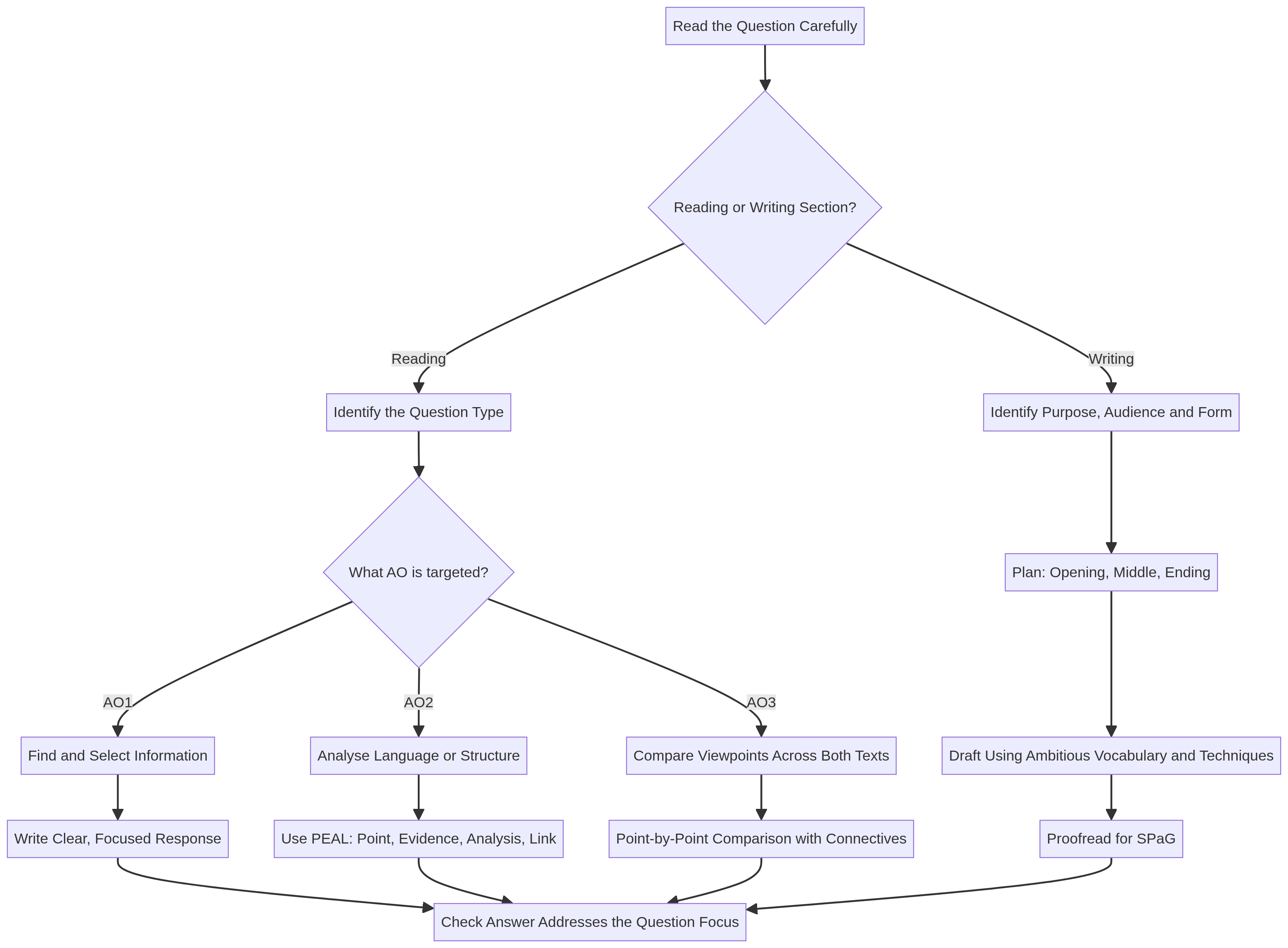

Interactive Diagrams
2 interactive diagrams to visualise key concepts
Conceptual Flow Outline
Exam Approach Flowchart
Conceptual Flow Outline
Comparison Structure Framework
Worked Examples
3 worked examples — open one to explore the question and available guidance.
Practice Questions
Test your understanding — click to reveal model answers
Read the extract. List four things you learn about the narrator's journey. (4 marks)
Hint: Look for explicit facts stated in the text. You do not need to write long paragraphs; brief, accurate sentences are fine.
How does the writer use language to describe the conditions in the factory? (8 marks)
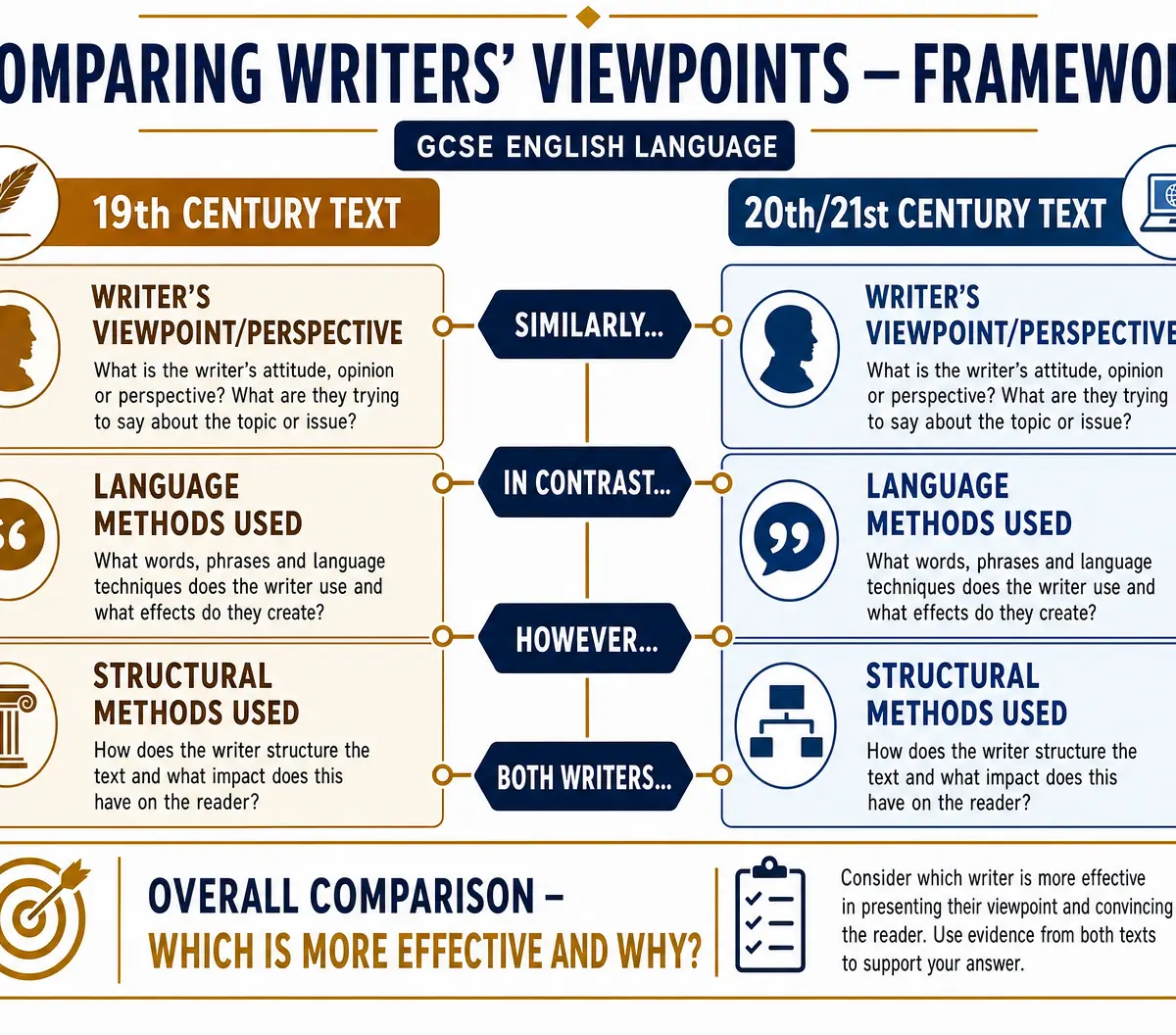
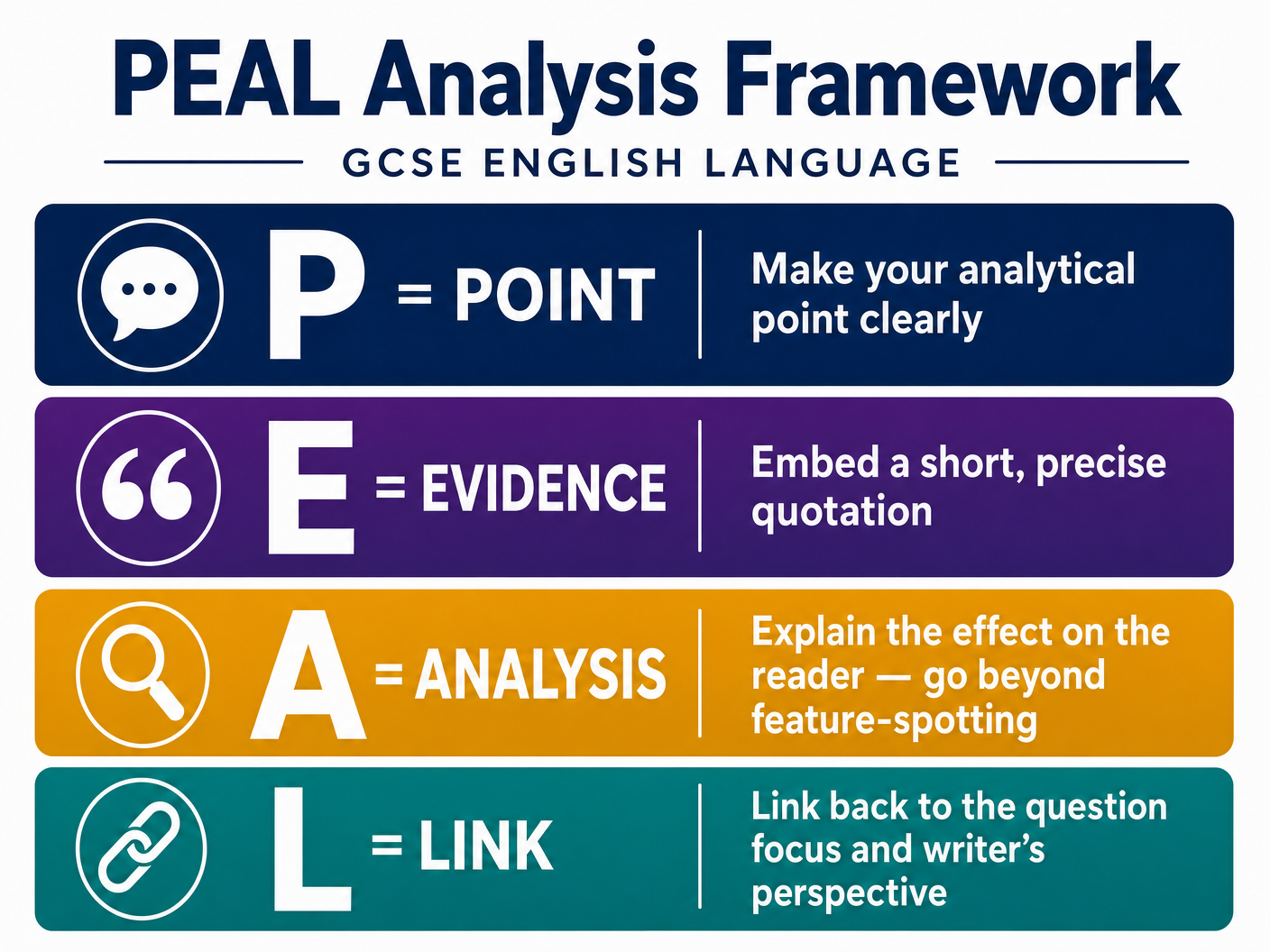
Hint: Identify specific techniques (e.g., metaphors, adjectives) and explain their effect on the reader. Use PEAL paragraphs.
Compare how the two writers convey their different perspectives on the natural world. (16 marks)
Hint: You must compare both the IDEAS and the METHODS. Use a point-by-point structure, alternating between Text A and Text B.
Write a letter to your local council arguing for or against the proposal to build a new shopping centre on the local park. (24 marks content, 16 marks SPaG)
Hint: Remember PAF: Purpose (to argue), Audience (local council - formal register), Form (letter - needs addresses, date, formal sign-off).
Write the text for a speech to be given to your school assembly about the importance of mental health awareness. (24 marks content, 16 marks SPaG)
Hint: A speech needs to engage a live audience immediately. Use direct address ('you', 'we'), rhetorical questions, and emotive language.